
Stellaris Planet Class IDs
67 Planet Class IDs
A complete and up-to-date searchable list of all Stellaris planet class IDs.
Change the class of the selected celestial body with the planet_class command and the planet class ID you want to change it to.
Used with the planet_class console command.
Command builder
Run with a planet selected to change its class.
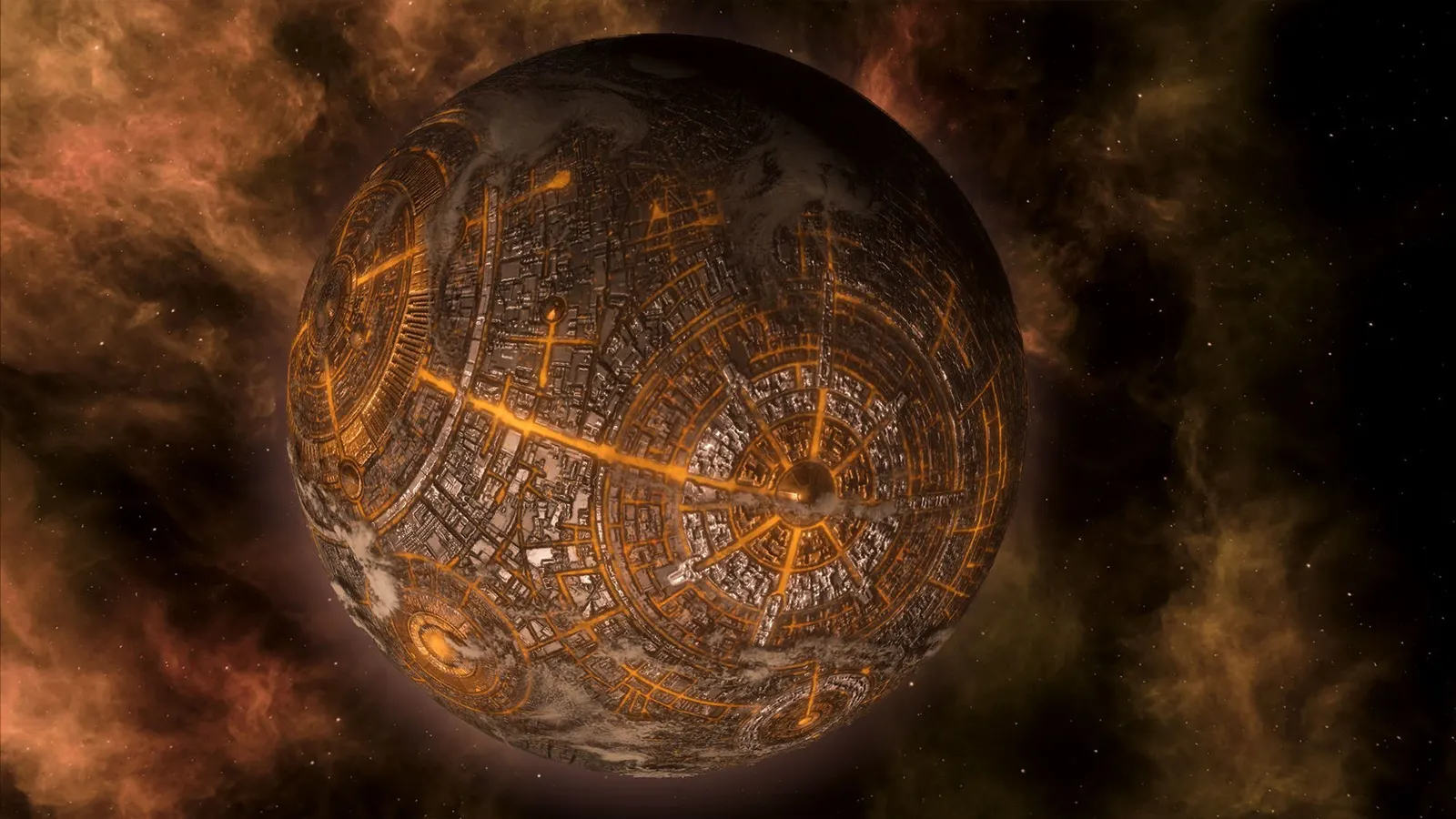
pc_ai
Rocky world covered with artificial structures. The thin atmosphere consists mostly of industrial pollutants. There are strong energy emissions coming from across the entire surface, but no organic life signs.
pc_alpine
Mountainous world with a nitrogen-oxygen atmosphere. Snow covers the mountaintops, and frozen-over lakes dot the valleys. While the planet experiences minimal seasonal variations, the still-liquid water beneath the frozen surface of the lakes is enough to sustain some hardy vegetation.
pc_arctic
Frigid, rocky world with a nitrogen-oxygen atmosphere. The poles are big, and significant water deposits can be found permanently frozen as glacial ice. However, the planet experiences seasonal variations and the equatorial band is covered by vegetation.
pc_arid
Dry, rocky world with a nitrogen-oxygen atmosphere. The dust-covered terrain consists largely of mesas and canyons. Forests can be found in the more temperate polar regions, but vegetation is otherwise scarce.
pc_ark
Our world became our ship and our ship became our world.
pc_asteroid
A larger asteroid or planetoid standing out in the dense cluster of smaller bodies.
pc_cutholoid
A larger asteroid or planetoid standing out in the dense cluster of smaller bodies.
pc_rift_star
In place of a star, the celestial bodies in this system orbit an ancient Astral Rift.
pc_astral_scar
This is an anomalous fold in space and time. Strange material leaks from its edges, but we cannot penetrate any further.
pc_barren
Barren and rocky world with a thin or non-existent atmosphere. The surface is covered in meteor impact craters and is completely devoid of life.
pc_barren_cold
Barren and rocky world with a thin or non-existent atmosphere. The surface is covered in meteor impact craters and is completely devoid of life.
pc_black_hole
Typically formed as a result of the collapse of a very massive star at the end of its life cycle, black holes have extremely strong gravity fields that prevent anything - including light - from escaping once the event horizon has been crossed. The gravitational waves emitted by black holes interfere with FTL drives, making it harder for ships to escape from combat.
pc_machine_broken
Rocky world covered with artificial structures. The thin atmosphere consists mostly of industrial pollutants. There are strong energy emissions coming from across the entire surface, but no organic life signs.
pc_broken
World devastated by some catastrophic event. Whatever properties it may once have had are no longer discernible.
pc_a_star
These relatively young white or bluish-white main-sequence stars are typically among the most visible to the naked eye. They are large and rotate very quickly, but will eventually evolve into slower and cooler red giants.
pc_b_star
The large class B main-sequence stars are very bright and blue. Although somewhat rare, the luminosity of these stars make them among the most visible to the naked eye.
pc_f_star
F-type stars are fairly large and often referred to as yellow-white dwarfs. Although they often emit significant amounts of UV radiation, their wide habitable zones have a good chance of supporting life-bearing worlds.
pc_g_star
Often referred to as yellow dwarfs, G-type stars actually range in color from white to slightly yellow. Main-sequence stars fuse hydrogen for roughly 10 billion years before they expand and become red giants. Although their lifespans are shorter than K-type stars, worlds inside the habitable zone of a G star often enjoy optimal conditions for the development of life.
pc_k_star
These main-sequence stars, sometimes referred to as orange dwarfs, are a fairly common sight. They are stable on the main-sequence for up to 30 billion years, meaning that worlds orbiting a K-type star have a longer than average window to evolve life.
pc_m_giant_star
With a large radius and comparatively low surface temperature, red giants are stars of moderate mass in a late stage of stellar evolution. Their expanded stellar atmospheres and high luminosity make for distant habitable zone orbits.
pc_m_star
The most common stars in the universe, often referred to as red dwarfs. Their low luminosity means they are difficult to observe with the naked eye from afar. Although they typically have an extremely long lifespan, red dwarfs emit almost no UV light resulting in unfavorable conditions for most forms of life.
pc_t_star
Brown dwarfs are substellar objects that lack the mass to sustain hydrogen fusion. Roughly the size of large gas giants, they have a much greater density. Their low luminosity and comparatively small heat generation means that planets orbiting them are unlikely to support life.
pc_continental
Rocky world with a nitrogen-oxygen atmosphere. Active and stable hydrosphere. Great landmasses are separated by oceans, with large climate variations depending on latitude and precipitation.
pc_egg_cracked
The cracked shards of an enormous planet-sized egg.
pc_rare_crystal_asteroid
A large asteroid covered in some kind of crystalline outcroppings.
pc_crystal_asteroid
A large asteroid covered in some kind of crystalline outcroppings.
pc_ringworld_habitable_damaged
Part of a Ring World, an immense band encircling the system's sun. This section of the megastructure appears irreparably damaged.
pc_ringworld_seam_damaged
Part of a Ring World, an immense band encircling the system's sun. This section of the megastructure appears irreparably damaged.
pc_ringworld_tech_damaged
Part of a Ring World, an immense band encircling the system's sun. This section of the megastructure appears irreparably damaged.
pc_desert
Dry, rocky world with a nitrogen-oxygen atmosphere. Precipitation and major bodies of surface water are relatively rare. Significant temperature variations between day and night cycles. Vegetation is scarce, but even moderate precipitation can make the desert bloom.
pc_city
World completely engulfed by urban-industrial sprawl. Its natural lithosphere is no longer discernible from orbit.
pc_frozen
Rocky world covered in a thick layer of permanently frozen ice. Low temperatures and a very thin atmosphere preclude the existence of life on the surface.
pc_gaia
An ideal, temperate world with a nitrogen-oxygen atmosphere and a resilient ecosystem. Optimal conditions for all known higher forms of life at different latitudes.
pc_gas_giant
Gaseous planet with an atmosphere primarily composed of hydrogen and helium surrounding a dense core.
pc_hive
This entire world is a giant living organism, psionically connected with the Hive Mind that shaped it. Any beings not part of the Hive that set foot here will be attacked by the very terrain itself.
pc_ice_asteroid
A larger asteroid or planetoid composed primarily of frozen H2O.
pc_infested
The surface of this world is covered by some kind of biological contaminant.
pc_junk
A large body of magnetized space junk composed of scrap metal, satellite remnants, and recaptured megastructure parts.
pc_machine
Rocky world covered with artificial structures. The thin atmosphere consists mostly of industrial pollutants and is not capable of supporting biological life.
pc_molten
Rocky world that is scorching hot. The atmosphere is thin or non-existent, and lava from the interior flows freely due to constant volcanic eruptions. This type of planet cannot sustain organic life.
pc_gray_goo
pc_nanotech
The flood has profoundly transformed this planet. Its landscape is now dominated by a dynamic sea of nanites in constant flux.
pc_neutron_star
These incredibly dense stellar remnants are sometimes created when a massive star suffers a rapid collapse and explodes in a supernova. Although their diameter is typically as little as ten kilometers, their mass is many times greater than an average G-type star. The gravitational waves and radiation emitted by neutron stars must be carefully navigated around, slowing the sublight speed of ships.
pc_ocean
Rocky world with a nitrogen-oxygen atmosphere and a significant hydrosphere. Oceans cover more than 90% of the surface, with scattered islands making up the remaining percentage.
pc_habitat
An artificial deep-space arcology offering planet-like - if decidedly urban - living conditions. Hydroponics and advanced filtering technologies make it near-self-sustaining, and station-borne facilities can mine the station's host planet for raw materials.
pc_protostar
A former Gas Giant, now undergoing stellar fusion following the injection of a highly energetic dark matter. Studying this would provide valuable insights.
pc_pulsar
Pulsars are highly magnetized neutron stars that emit beams of electromagnetic radiation. As the star rotates, the radiation beam is only visible when it is pointing directly at the observer. This results in a very precise interval of pulses, which sometimes is so exact that it can be used to measure the passage of time with extreme accuracy. The radiation emitted by pulsars interferes with deflector technology, rendering ship and station shields inoperable.
pc_relic
A city once stretched across this entire world. Only ancient and abandoned ruins remain now, their original inhabitants long since departed.
pc_ringworld_habitable
Part of a Ring World, an immense band encircling the system's sun. Built to allow for numerous artificial habitation zones along its inner span, freed from the restrictions and mundanity of planet-bound, spherical existence.
pc_ringworld_seam
Part of a Ring World, an immense band encircling the system's sun. Built to allow for numerous artificial habitation zones along its inner span, freed from the restrictions and mundanity of planet-bound, spherical existence.
pc_ringworld_tech
Part of a Ring World, an immense band encircling the system's sun. Built to allow for numerous artificial habitation zones along its inner span, freed from the restrictions and mundanity of planet-bound, spherical existence.
pc_cybrex
Part of a Ring World, an immense band encircling the system's sun. Built to allow for numerous artificial habitation zones along its inner span, freed from the restrictions and mundanity of planet-bound, spherical existence.
pc_savannah
Rocky world dominated by dry, arid plains covered by a nitrogen-oxygen atmosphere. The small hydrosphere allows for brief wet seasons, but aside from a few ubiquitous grasses, vegetation is largely concentrated around shallow oases.
pc_shattered_ring_habitable
Part of a Ring World, an immense band encircling the system's sun. This section of the megastructure has sustained damage - especially to some of its more advanced districts - but it does not appear irreparable.
pc_shattered
The charred, broken remnants of what was once a planet. A massive energy surge has detonated this world's core, leaving only drifting slabs of rock.
pc_shattered_2
The charred, broken remnants of what was once a planet. A massive energy surge has detonated this world's core, leaving only drifting slabs of rock.
pc_habitat_shielded
This Habitat station is encased in some kind of impenetrable energy barrier. It blocks all scans of its interior.
pc_ringworld_shielded
This Ring World segment is encased in some kind of impenetrable energy barrier. It blocks all scans of the surface.
pc_shielded
pc_shrouded
Our sensors are unable to penetrate the thick fog surrounding the planet. Ships that enter it do not return.
pc_cosmogenesis_world
A colossal reservoir computing system designed to connect billions of sentient beings, organic or synthetic, via an intricate array of cables, transistors, and life support pods. The intensive strain on individual processing organs will inevitably lead to brain damage for any networked 'component.'
pc_nuked
A rocky world with a nitrogen-oxygen atmosphere. It is currently experiencing a nuclear winter, with dense layers of sooty aerosols in the atmosphere. High levels of surface radiation. Minimal signs of life.
pc_toxic
A rocky planet with a thick atmosphere that is lethal to all known higher forms of life.
pc_tropical
Humid, rocky world with a thick nitrogen-oxygen atmosphere. Seasons with significant precipitation are interchanged with drier periods. Most landmasses are covered in dense vegetation.
pc_tundra
Cold and rocky world with a nitrogen-oxygen atmosphere. Permafrost covers most of the surface except for the more temperate equatorial regions. A stable biosphere exists but vegetation is mostly limited to mosses and lichens.
pc_toxoid_star
Millennia of exposure to the Toxic Entity have caused alterations in the makeup of this star. Though once it was a fairly standard G-type star, now it emits an eerie green haze unlike any seen elsewhere in the galaxy.
pc_volcanic
Rocky world with a sulfur rich atmosphere and a partially liquid lithosphere. The ash and basalt covered surface is interspersed with fresh volcanic activity, lava lakes and rivers. Only extremophile life forms can be found, if any.